The story
Between September 1939 and July 1945 the Belgian merchant navy lost fifty-one ships and more than fifteen hundred people. This is how that happened: what a small country with a large fleet did when its own ports were occupied, and what it cost.
A small country with a large fleet
In 1939 Belgium had barely seventy kilometres of coast and no tradition of naval power, but it did have a merchant fleet that in September of that year measured 472,182 gross tons. Two things explain it: Antwerp, after Rotterdam the largest port on the continent, and the Congo. The Compagnie Maritime Belge ran to Matadi and Boma with passenger ships that were household names in Antwerp – the Albertville, the Elisabethville, the Leopoldville, the Thysville. Alongside them sailed dozens of smaller owners: five-hundred-ton coasters running to England and France, tankers for Purfina of Ghent, cargo ships of Deppe.
A little over half of that fleet was left after six years of war. What follows is the part for which a crew list survives: sixty-six lists, together 2,417 people.
Neutral, and already burying men
Belgium was neutral until 10 May 1940, but the sea was not. On 15 September 1939, a fortnight after the German invasion of Poland, the Alex van Opstal struck a German mine south of Weymouth. Everyone got off. She was the first Belgian merchant ship lost in this war, and it happened eight months before Belgium was in it.
Others followed. The Rosa in December, the Josephine-Charlotte and the Meuse in January 1940. The Meuse was a coaster of six hundred and eighty-one tons with twelve men aboard. All twelve drowned. That is the pattern that returns throughout the war: the smaller the ship, the smaller the chance that anyone comes off her.
17 May 1940: one telephone call
Seven days after the invasion, with the Belgian army still in the field, the Director-General of Marine telephoned from Brussels to the embassy in London with the order to requisition the entire merchant fleet. The embassy signalled it on to Belgian diplomats and consuls around the world. From that moment the ships sailed not for their owners but for the government in exile, chartered to the British Ministry of War Transport.
In practice it meant this: a ship lying in Rio or in Lourenco Marques was told by telegram that she now sailed under Allied orders. Her crew could not go home – home was occupied. Many would not see their families for five years. The owners went on existing on paper, but decided nothing.
London, and the men behind the gun
The fleet had been requisitioned – but by whom, exactly? In May 1940 the Belgian government was not in London. It was in France, and when the British offered on 20 June 1940 to bring it over, Prime Minister Pierlot declined; he wanted first to see to displaced Belgians. Only in October 1940 did the government reach London.
In the meantime the fleet was run by a committee. As early as 11 May 1940, the day after the invasion, the Belgian Shipping Advisory Committee had been set up at the Belgian embassy in London, with oversight of every Belgian ship that had stayed out of German reach. The Pierlot government’s man in London was René Boël of that committee. In those same weeks the entire fishing fleet was requisitioned too: 507 vessels, of which about half reached England.
Once the government did arrive, the merchant navy fell not to National Defence but to Camille Gutt, minister of finance and of communications – because that is where seafaring had belonged before the war.
The Belgian Marine
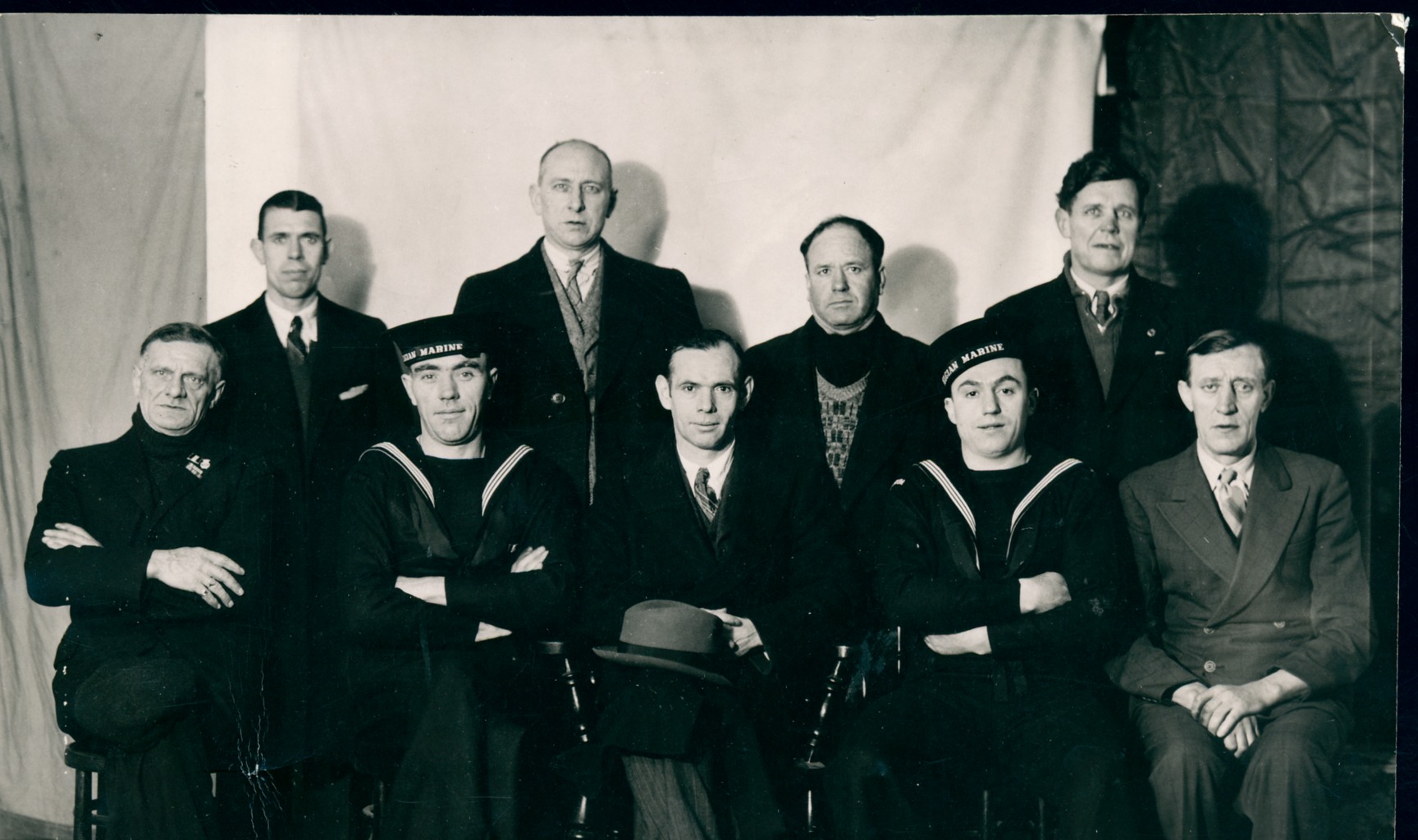
Merchant ships were given guns, and guns need gunners. The Dutch and the Norwegians took theirs from their navies. Belgium had no navy, and in November 1940 chose its own way: a separate force, the Belgian Marine. The army loaned the men. They were trained at the British D.E.M.S. centre in Liverpool, wore British naval uniform with a Belgian Marine cap tally and BELGIUM shoulder tabs, and sailed in the merchant ships. The unit was disbanded at the end of the war.
That force is not the Zeemacht, the Belgian Navy. There was no Belgian Navy during the war: it was founded only in 1946, out of the Royal Navy Section Belge, the Belgian branch of the British navy in which mostly fishermen served. The Belgian Marine was something else – not a navy but the army at sea, for the merchant ships’ guns alone, and disbanded when the war ended. Where the Belgian Navy does come from has a page of its own.
The crew lists in this database hold 176 gunners. Eighty-two of them are recorded as British; most of the rest carry no nationality at all, which in this source means Belgian. The President Francqui sailed with seven gunners and a chief gunner aboard, Belgians and Britons together.
A man already in the merchant service, incidentally, was not allowed to leave it. Crew of Belgian merchant ships were expressly forbidden to enlist in the Belgian section of the Royal Navy, precisely so as to keep the merchant navy at strength. Only in December 1942 did the government release the seamen serving in the army: about a hundred men, of whom the merchant mariners went back to the merchant service and the fishermen to the navy.
June 1940: four ships in eleven days
When the German advance reached the Channel coast, Belgian ships were lying in French ports. On 11 June 1940 three were lost in a single day. The Albertville, eleven thousand tons, was bombed off Le Havre; so was the Piriapolis. The little Yvonne went down with ten of her eleven crew.
Counted in ships, June 1940 is the worst month of the entire war. Not in the Atlantic, but just off the coast of Normandy, within sight of land.
The Battle of the Atlantic
From the autumn of 1940 everything moved out to the ocean. Ships sailed in convoy, twenty or fifty at a time, in columns, at the slowest speed the slowest of them could still make. A Belgian ship rarely sailed with other Belgians; she was given her station in the convoy like anyone else. The convoy page shows which convoys we know of.
1941 and 1942 were the worst years: seventeen ships in 1941, eleven in 1942 – but those eleven were larger and more heavily manned. On 22 January 1942 the Gandia was torpedoed. Of seventy-nine aboard, sixty-five died. For each man it is recorded which lifeboat he reached, number 2 or number 4; most of them died in the boat all the same. Fourteen came through.
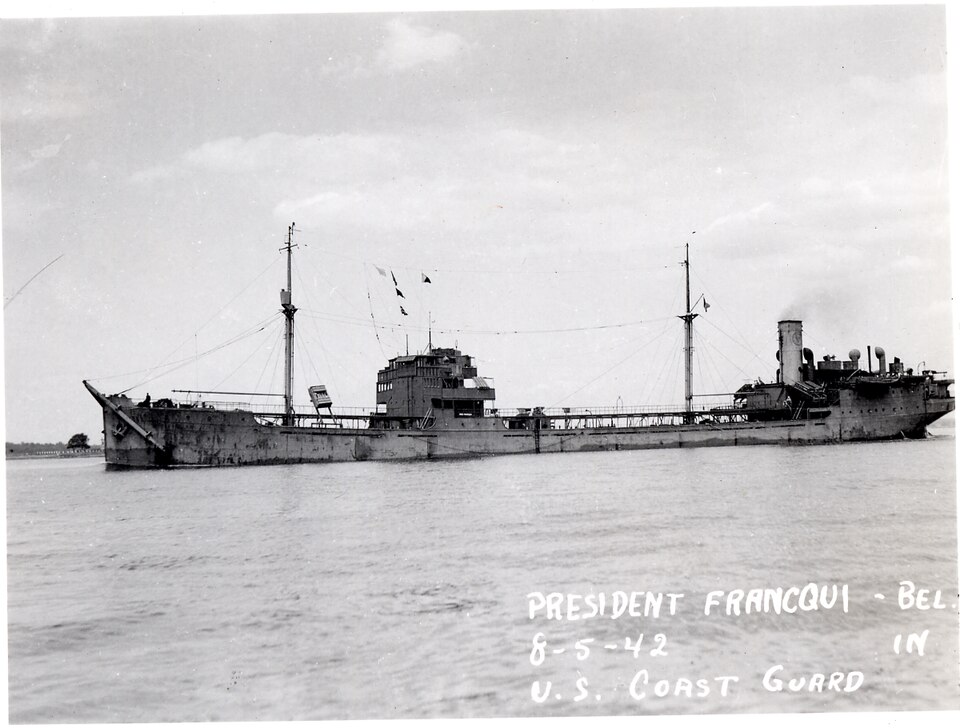
Eleven months later, in December 1942, the Compagnie Maritime Belge lost within twelve days two ships named after the same man: the Emile Francqui on the sixteenth, with fifty-two dead, and the tanker President Francqui on the twenty-eighth. Aboard the second sailed Constant Senten, provisions steward. He took his place on the small raft towed behind the boat. On the night of 31 December the line parted.
The Congo run kept going
The Congo service held throughout the war and mattered more than ever: copper, rubber, palm oil and uranium came by sea to the Allied war industry. That made the Congo ships targets too. The Kabalo, the Kasongo, the Moanda, the Mokambo – the names on the loss list read like a map of Katanga.
Nearly fifty Congolese seamen appear in the crew lists. In this database they carry the nationality the source prints – “Kongo” or “Kongolees” – and often without a forename, sometimes without a surname. That is how it was written down.
The training ship Mercator
One group of those officers can be followed closely, because a diary of their voyage survives. The training ship Mercator, a barquentine of 779 tons, left Ostend on 21 February 1940 for her twentieth cruise: Tenerife, Rio de Janeiro, St Helena and home, four months. Seventy-five aboard, under Commandant Remy Van de Sande. Because Belgium was neutral, a house-high Belgian flag was painted on both flanks, lit by a searchlight at night. On the way out old pilot boats of the Corps de Marine steered her through the mines; three drifted past at a hundred metres.
Cadet André Demortier kept a diary in French, with drawings of boats and coastlines. On 10 May 1940 he wrote across the top of the page: War between Belgium and Germany. At half past four in the morning they were mustered in the fo’c’sle, where the commandant brought the news, made a fiery speech and ended with “Long live Belgium!” Everyone was moved to tears. They ran 164 miles that day.
After that they were welcome nowhere. At St Helena they met the contempt of the French and the English, so the commandant took the ship into neutral Portuguese water. On 13 May they entered Lobito, where two German ships with swastika flags had also taken refuge. No instructions came from anyone. Stores ran down; the pasta was full of small brown creatures and at table they counted who had scooped the most out of his macaroni. There was grumbling, and even whispers of mutiny.
When Belgium capitulated Van de Sande sailed for the only Belgian soil left. On 1 June 1940 the anchor went down in the creek of Banana at the mouth of the Congo; on the sixth they reached Boma. On 21 June every cadet had to be at the Fort of Shinkakasa at half past four in the morning to draw a rifle, ammunition and even a machine gun, and to be told they were now under military discipline. Which authority had ordered it was never made clear.
What London was to do with them
London knew perfectly well the ship was there. On 6 July 1940 a secret telegram from the British consul-general reached the Admiralty and the Foreign Office:
“Belgian training ship MERCATOR at Banana has 30 cadets age 17 to 19 and 5 officers. Government asks whether use can be found for the cadets as merchant marine officers and possible employment of ship or officers in South African waters.”
The Admiralty thought it a good idea and wrote on 31 July that their Lords considered it “very desirable” to use the cadets as proposed. But the British Ministry of Shipping was, in the words of the file itself, dilatory and unhelpful. And the Belgian Committee of Shipping refused to have anything to do with it. Commandant Barbé of that committee argued that “the cadets do not speak English”.
That is the hinge of this story. Had the committee decided otherwise in July 1940, the Mercator’s crew would have gone into the merchant navy – and the Royal Navy Section Belge would have had to make do with some fishermen and a few ferry officers. Because the merchant service would not have them, they became the nucleus of what in 1946 became the Belgian Navy. Minister Gutt wrote it out on 27 November 1940: those who could not be used in the merchant navy would fulfil their military obligations at Tenby in Wales, and “le but final de l’entrainement est la constitution éventuelle d’unités de marine de guerre”.
H.M.S. Mercator
The ship herself stayed behind. To raise money the commandant contracted with the Compagnie Maritime Belge to carry sixty tons of potatoes from Boma to Lobito for the Leopoldville. The chief steward brought piglets aboard and built a pen against the spare propeller; cleaning it was known aboard as corvée cochons.
On 21 November 1942 the charter party was signed with the Ministry of War Transport, acting for the Royal Navy. On 24 January 1943 she left for Lagos under her own power, escorted by the trawler Rumba, and on 8 February 1943 entered the submarine base at Freetown. From the fifteenth she flew the White Ensign, attached administratively to H.M.S. Philoctetes, with Sub-Lieutenant Brodie in command. She was now H.M.S. Mercator and served two years as a floating rest home for submarine crews coming in from Atlantic patrol.
She was released in August 1945. Below the waterline forty thousand pits had to be welded up, the engines were finished, the rigging unsafe. She could not sail. The deep-sea tug Empire Mary took what was left of her in tow at Boma early in 1946; two of the tow runners lost their lives on the passage. On 18 January 1947 the Mercator saw the Scheldt again, a hulk – seven years after a voyage planned for four months. Cadet Roger Ghys had got home earlier, in November 1945, working for passage on a Norwegian tanker. Almost six years after he left.
A large part of her cadets ended up in the Royal Navy; how that happened is on the page about the Belgian Navy.
She was restored and has lain at Ostend as a museum ship since 1964. The British ensign she was given in 1945 still hangs aboard. Photographs from her Freetown years, and the way to the museum ship, are under documentaries.
Overlord, and the two stokers
In June 1944 three Belgian ships took part in Operation Overlord: the Belgique, the Julia and the Marcel. On the Belgique's crew list stand two stokers, Van Gheluwe Edgard and Van Melkebeke Pieter. They were in fact gunners. They had pressed to be allowed to take part in the landings, and signed on as stokers to manage it.
Half a year later, on Christmas Eve 1944, the Leopoldville was torpedoed five miles from Cherbourg with more than two thousand American soldiers aboard. Seven hundred and sixty-three of them died. It was the heaviest loss an American infantry division suffered from a submarine in this war, and it was kept quiet for more than fifty years.
The price
The lists in this database give these figures: fifty-one ships actually lost, together 242,036 gross tons, and 1,592 dead. Those 242,036 tons are more than half of the 472,182 the fleet measured in September 1939.
The last loss falls in July 1945, two months after the German surrender: the Emeraude, not an act of war but a marine accident. The war at sea did not stop because there was peace in Europe. The figures page sets these losses out month by month.
What was left
Those who came back came back to a country that had run five years without them and knew little of what had happened at sea. There was no battlefield to visit, no front that had stood on a map. What there is are the crew lists, the sworn declarations drawn up at embassies, and the memory of the people themselves.
Those papers are why this database exists, and why it can still grow. Every name here is a name off such a list. Anyone holding a photograph, a document or a correction can pass it on – several pages on this site are here because readers did.
One more story runs alongside this one: that of the Belgians who served not in the merchant navy but in the Royal Navy, and of the Belgian Navy that grew out of their branch in 1946. They have a page of their own.