
The Belgian merchant navy and sea fishery at war
A searchable database of the Belgian ships and their crews in the conflicts since 1830: who was aboard, what rank he held, where he came from, and what became of him.
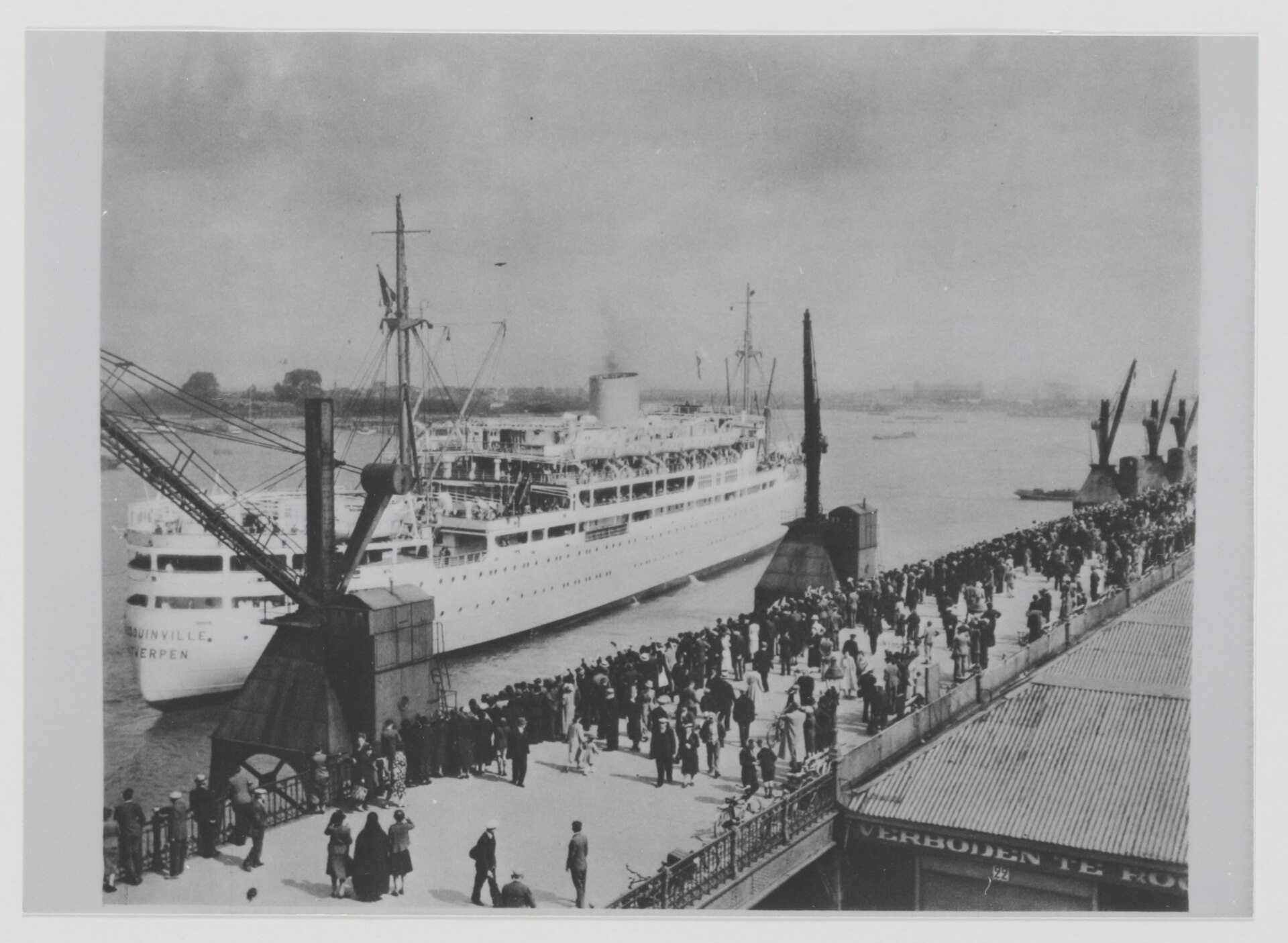
The last departure of the Baudouinville from Antwerp. Photo: MAS Antwerp, public domain.
| Name | Rank | Ship |
|---|
From 1830 to today
Since Belgium raised its own flag in 1830 its merchant navy has been caught up in seven armed conflicts, and its sea fishery hardest of all. The Second World War is the best documented and forms the core of this database; the First cost the fleet proportionally more. In the later conflicts the Belgian contribution was mainly naval, and little about the merchant service itself was recorded. What follows says, for each period, how much we actually hold.
- 1830–1839Independence and the closing of the ScheldtNo ship lost in action, and still the heaviest blow: Antwerp was cut off from the sea and stayed cut off for thirty years.Blockade · background
- 1914–1918The First World WarThe fleet's worst war. Almost the whole coastal fishery fled to England; 74 fishermen died and the merchant navy lost forty per cent of its tonnage.War · vessels by name
- 1939–1945The Second World WarThe core of this database: sixty-six crew lists, the ships that were lost and the people who were aboard.War · full database
- 1950–1953The Korean WarThe Belgian volunteer corps sailed from Antwerp to Pusan aboard the state vessel Kamina. No merchant loss is known.War · background
- 1960The Congo CrisisThe CMB's Congo liners carried evacuees away, but the armed action at Matadi was naval, not merchant.Crisis · background
- 1980–1988The Gulf tanker warIran and Iraq attacked shipping 451 times between them. Belgium sent minehunters, and the Belgian tanker Naess Leopard was hit herself by two Iranian rockets.War · vessels by name
- 1990–1991The Gulf WarMinehunters again: Operation Southern Breeze, and afterwards command of a Belgian-French-Dutch clearance group.War · background
- 2009Piracy: the PompeiTen crew held for more than seventy days by Somali pirates. It led to the first conviction of a pirate kingpin in Europe.Hijacking · vessels by name
Where they were hit
The First World WarThe Second World WarThe Gulf tanker warPiracy: the Pompei
The map shows 130 incidents. A dot is a place the source names; a faint circle around it means we know only the area, and the circle is as large as that uncertainty - 31 of the 130 appear that way. Colour is the conflict, the size of the dot the number who died. Click the map to zoom.
The Second World War close up
Of all the conflicts this one is worked out in the most depth, because its crew lists survive. What follows concerns that war alone.
Heaviest losses
- LEOPOLDVILLE · 770 lost, 24 December 1944
- ASTRIDA · 88 lost, 19 March 1945
- GANDIA · 65 lost, 22 January 1942
- EMILE FRANCQUI · 56 lost, 16 December 1942
- VILLE D'ARLON · 56 lost, 2 December 1940
- CARLIER · 48 lost, 11 November 1943
- INDIER · 42 lost, 3 April 1941
- ROUMANIE · 42 lost, 24 September 1942
Not everyone is here
The source counts 270 people aboard without ever naming them – Congolese, Arab and Senegalese crew, soldiers, repatriated passengers. 37 of them died. They are counted here but cannot be searched for. That is a gap in the source, and it is kept visible rather than left out.
What the cross-references reveal
Because the same man can appear on several ships, connections surface that stay invisible in a printed list. Four men survived the Rosa in December 1939 and died five weeks later on the Meuse. Both nurses of the Leopoldville survived Christmas Eve 1944 and died seven weeks later on the Persier. Seven of the Carlier's crew endured internment at Dakar, sailed again, and all seven died when she was torpedoed in November 1943.