Ships › PRESIDENT FRANCQUI
M/T PRESIDENT FRANCQUI
Lost during the Second World War
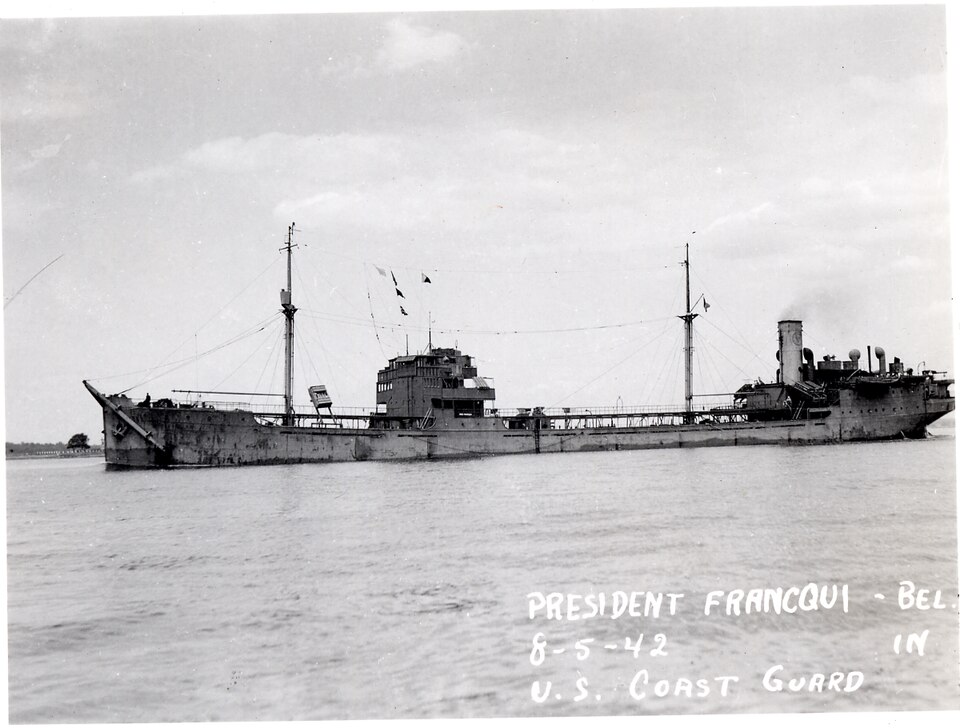
More photographs (1)
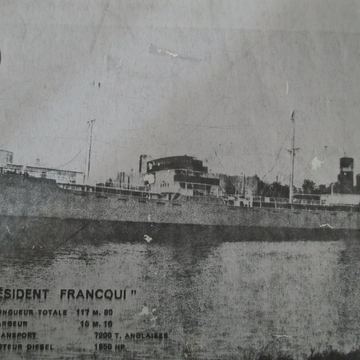
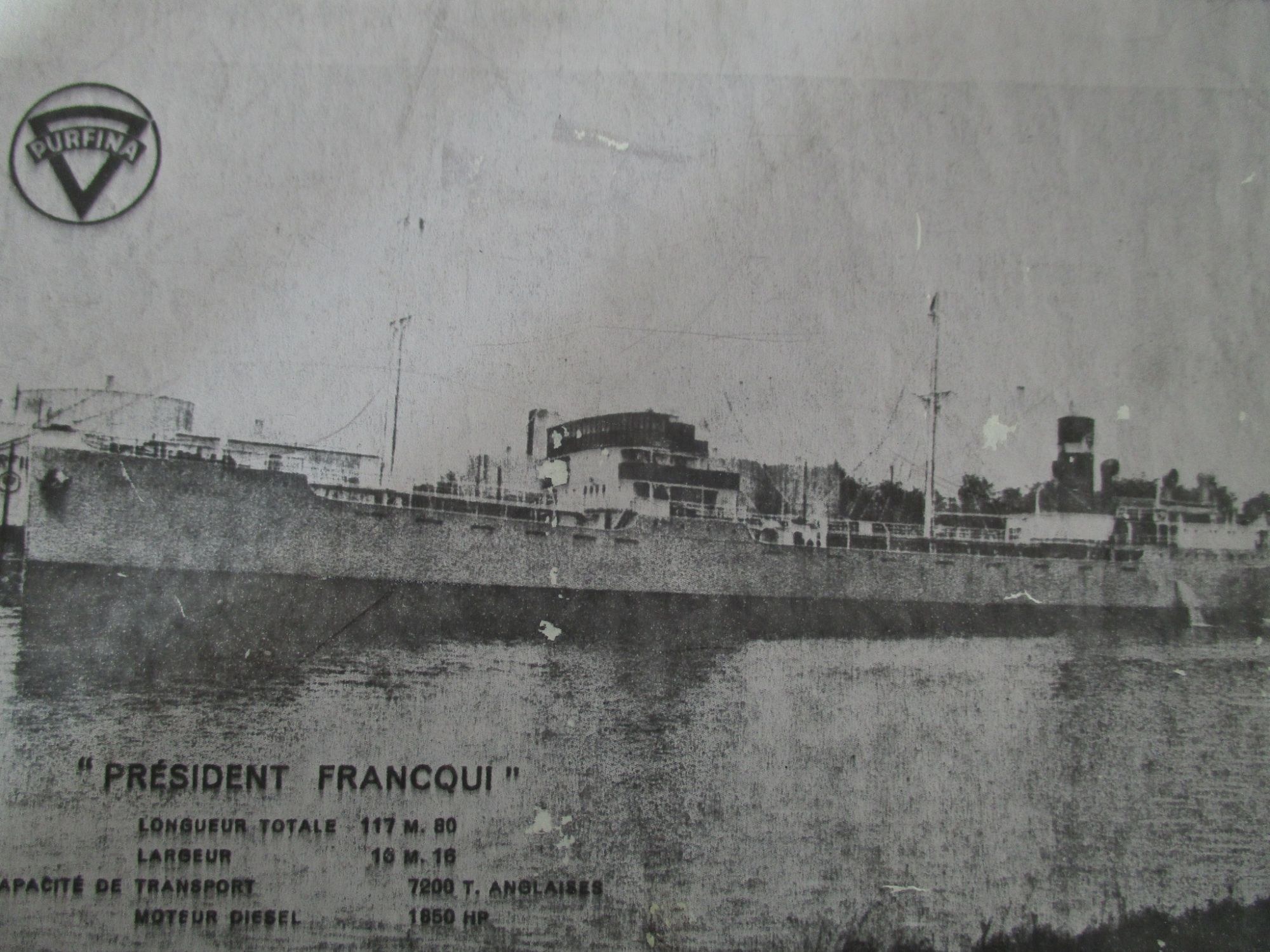
Purfina display panel showing the Président Francqui and her principal dimensions. Photographer unknown · Published by permission
- Type
- Motor tanker
- Tonnage
- 4,919 GRT
- Built
- 1928 – New Waterway Shipbuilding Co, Schiedam
- Owner
- Compagnie Financière Belge des Pétroles (Petrofina) SA, Antwerp
- Home port
- Ghent
- Date
- 28 December 1942
- Fate
- Sunk by U-336 (Hans Hunger)
- Attacker
- U-336 (Hans Hunger)
- Convoy
- ONS-154 (straggler)
- Voyage
- Belfast → New York
- Cargo
- Ballast
- Position
- 43.3833, -27.2333 · grid CE 3142
Position of the attack. Click the map to enable zoom.
Crew list (49 names)
The voyage
- Departure
- Belfast · 18 December 1942
- Destination
- New York · never reached
- Sunk
- 28 December 1942
| Rank | Name | Nationality | Fate |
|---|---|---|---|
| Master (Kapitein) | Bayot Gilbert prisoner of war | Survived | |
| 1st Officer (1ste officier) | Lagay André | Survived | |
| 2nd Officer (2de officier) | Couteaux Edouard | Survived | |
| 3rd Officer (3de officier) | Van Wallendael Fernand | Survived | |
| 4th Officer (4de officier) | Kestemont Fernand | Survived | |
| 1st Radio Officer (1ste marconist) | Mycke Adrien | Survived | |
| 2nd Radio Officer (2de marconist) | Leclercq Maurice | Wounded | |
| Carpenter (Timmerman) | Goossens Jozef | Survived | |
| Boatswain (Bootsman) | Eyskens Constant | Wounded | |
| Able Seaman (A.B.) | Aelterman Karel | Survived | |
| Able Seaman (A.B.) | De Clopper Pieter | Survived | |
| Able Seaman (A.B.) | Houdenaert Charles | Survived | |
| Able Seaman (A.B.) | Hiersoux Roger | Survived | |
| Able Seaman (A.B.) | Mommen Adolf | Survived | |
| Able Seaman (A.B.) | Saeys Edward | Survived | |
| Able Seaman (A.B.) | †Van Holderbeke Daniel | Lost | |
| Able Seaman (A.B.) | Verdonck Désiré | Survived | |
| Able Seaman (A.B.) | Vermeulen Oscar | Survived | |
| Ordinary Seaman (Lichtmatroos) | Learmont Charles | United Kingdom | Survived |
| Chief Engineer (Hfd-werktuigk.) | Ronne Johannes | Survived | |
| 2nd Engineer Officer (2de mecanicien) | De Boey Emiel | Survived | |
| 3rd Engineer Officer (3de mecanicien) | Convents Willy | Survived | |
| 4th Engineer Officer (4de mecanicien) | Ghyoot Jacques | Survived | |
| 5th Engineer Officer (5de mecanicien) | Goetghebeur Jozef | Survived | |
| 6th Engineer Officer (6de mecanicien) | Baetens Jozef | Survived | |
| 7th Engineer Officer (7de mecanicien) | Lemoine Frans | Survived | |
| Deck Engineer (Dek-mecanicien) | †Uyttendaele Leopold | Lost | |
| Donkeyman | De Lion Jean-Baptiste | Survived | |
| Donkeyman | Goelen Philip | Survived | |
| Donkeyman | Van Staeyen Jozef | Survived | |
| Greaser (Smeerder) | Coppens Jozef | Survived | |
| Greaser (Smeerder) | Folbroeck Florent | Survived | |
| Greaser (Smeerder) | Raes Johannes | Survived | |
| Steward | †Senten Constant on the small raft, never found | Lost | |
| Messroom steward | Baete René | Survived | |
| Assistant steward | De Schrijver Arthur | Survived | |
| Messroom Steward (Messroom-steward) | Hill William | United Kingdom | Survived |
| Cabin Boy (Garçon de cabine) | Sullivan Frederick | United Kingdom | Survived |
| 1st Cook (1ste kok) | Van Roten René | Survived | |
| 2nd Cook and Baker (2de kok-bakker) | Vaz Kenneth | United Kingdom | Survived |
| Cook's Mate (Koksmaat) | Knight William | United Kingdom | Survived |
| Chief Gunner (Chief-gunner) | Vercammen Jan | Survived | |
| Gunner | †Bayot Léon | Lost | |
| Gunner | Celmayster Sylvain | Survived | |
| Gunner | †Claessens Albert | Lost | |
| Gunner | Friell Charles | United Kingdom | Survived |
| Gunner | Schoonjans Ernest | Survived | |
| Gunner | Smith James | United Kingdom | Survived |
| Gunner | Van Cutsem Theodoor | Survived |
The convoy ONS-154
- Route
- Outward, northbound, slow (North Atlantic)
- Dates
- 26–30 December 1942
- Escort
- Canadian group C1: St-Laurent with five corvettes and the rescue ship Toward
- Merchant ships
- 45
- Sunk
- 16 · 69,913 tons
- Damaged
- 10 · 57,777 tons
The dotted line follows the great circle the ONS series ran, Liverpool to New York, with the coastal bends the fairway imposes. The red point is where the Belgian ship was hit, from the U-boat’s attack report.
About the line on this map
A convoy steered the great circle: the shortest way over the globe, not the straight line on the map. That is why the Atlantic crossing here runs so far north, and why ships on that route were hit around 55 to 58 degrees and not at 48. The bends closer to land follow the fairway – the North Channel above Ireland, round Land’s End, through the Strait of Gibraltar.
The line is the route of the series, not the track that one convoy actually steered. The Admiralty shifted convoys north or south from sailing to sailing, according to the season and where the U-boats were; ONS-154 was deliberately routed south past the Azores in December 1942. And a straggler or a dispersed ship was by definition no longer with the group. Where the red point sits far from the line, that is usually what you are looking at.
The worst-hit convoy in this list: sixteen ships sunk and ten damaged out of forty-five. The President Francqui was a straggler.
Convoys (21)
From the Arnold Hague Convoy Database. Convoys only, not independent voyages: a ship sailing alone does not appear. See the convoy page.
| Convoy | Departed | Route | Sunk |
|---|---|---|---|
| EN.87/1 | 18 March 1941 | Methil – Oban | |
| OB.299 | 19 March 1941 | Liverpool - Dispersed | |
| HX.136 | 30 June 1941 | Halifax – Liverpool | |
| WN.154 | 16 July 1941 | Oban – Methil | |
| ON.9 | 20 August 1941 | Liverpool - Dispersed 54.51N 20.42W | 1 sunk |
| ON.11 | 30 August 1941 | Liverpool - Dispersed | |
| SC.45 | 18 September 1941 | Sydney CB – Liverpool | |
| ON.33 | 3 November 1941 | Liverpool - Dispersed 43.30N 55.20W | |
| ON.50 | 24 December 1941 | Liverpool - Dispersed | |
| SC.69 | 10 February 1942 | Halifax – Liverpool | |
| OS/KMS.24 | 2 April 1942 | Liverpool – Freetown | |
| SL/MKS.111 | 24 May 1942 | Freetown – Liverpool | 1 sunk |
| ON.114 | 19 July 1942 | Liverpool - Dispersed | |
| KS.532 | 19 August 1942 | Hampton Roads – Key West | |
| NG.302 | 3 September 1942 | NYC – Guantanamo | |
| GAT.4 | 10 September 1942 | Guantanamo – Trinidad | |
| TAG.7 | 19 September 1942 | Trinidad – Guantanamo | |
| GN.7 | 26 September 1942 | Guantanamo – NYC | |
| SC.105 | 11 October 1942 | NYC – Liverpool | |
| BB.232 | 2 November 1942 | Belfast Lough – Milford Haven | |
| ON.154 | 18 December 1942 | Liverpool – NYC | 13 sunk |
Documents
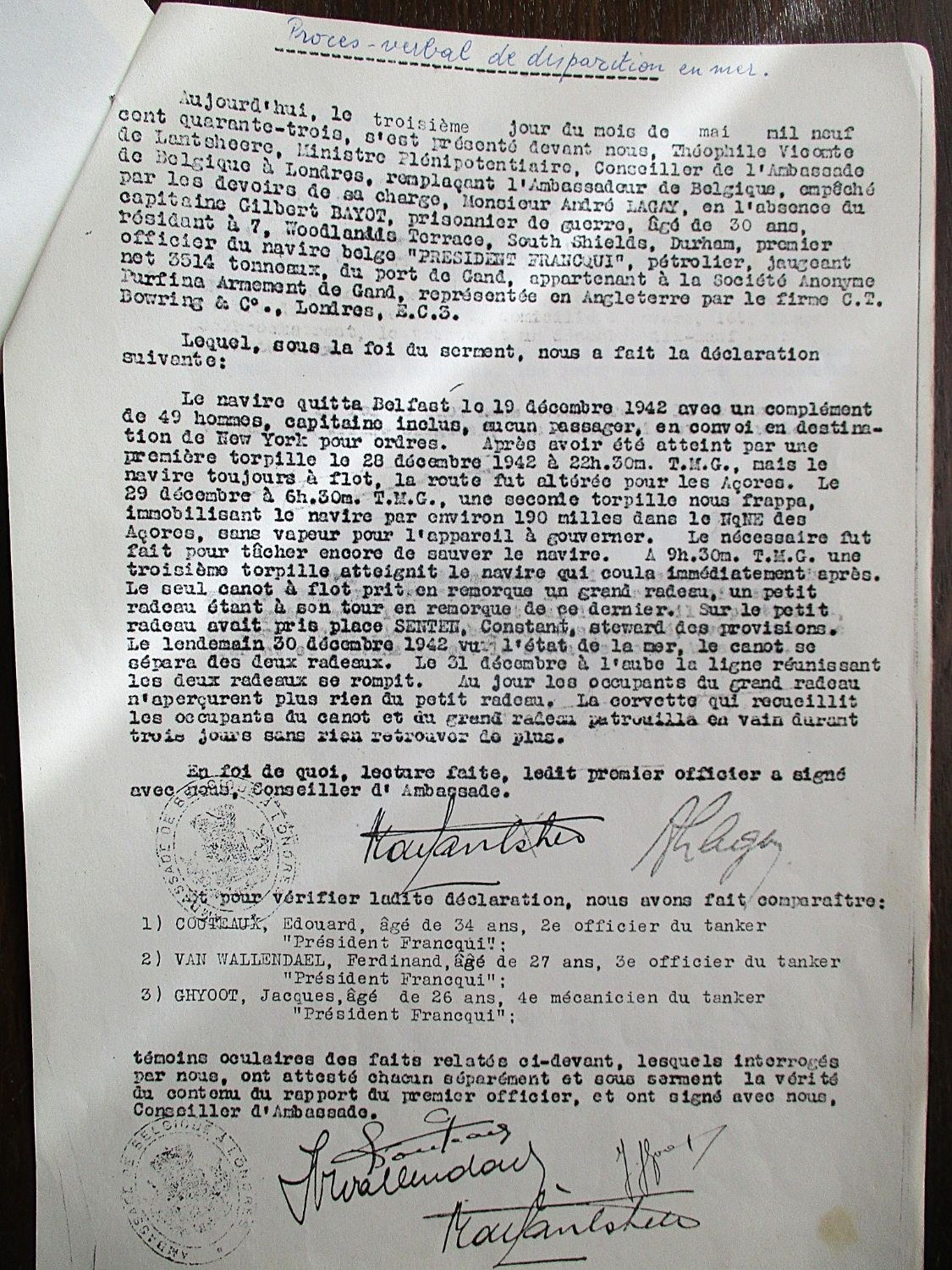
Read the transcript
Record of disappearance at sea.
This day, the third day of the month of May nineteen hundred and forty-three, there appeared before us, Théophile Viscount de Lantsheere, Minister Plenipotentiary, Counsellor of the Belgian Embassy in London, acting for the Belgian Ambassador, prevented by the duties of his office, Mr André LAGAY, in the absence of Captain Gilbert BAYOT, prisoner of war, aged thirty, residing at 7, Woodlands Terrace, South Shields, Durham, first officer of the Belgian vessel "PRESIDENT FRANCQUI", tanker, of 3,514 tons net, of the port of Ghent, belonging to the Société Anonyme Purfina Armement de Gand, represented in England by the firm C.T. Bowring & Co., London, E.C.3.
Who, upon oath, made to us the following declaration:
The ship left Belfast on 19 December 1942 with a complement of 49 men, the captain included, no passengers, in convoy bound for New York for orders. After being struck by a first torpedo on 28 December 1942 at 22h.30m. G.M.T., the ship still afloat, course was altered for the Azores. On 29 December at 6h.30m. G.M.T. a second torpedo struck us, disabling the ship about 190 miles north by east of the Azores, with no steam for the steering gear. What was needed was done to try to save the ship still. At 9h.30m. G.M.T. a third torpedo hit the ship, which sank immediately afterwards. The only boat still afloat took a large raft in tow, a small raft being in its turn towed behind the latter. On the small raft was SENTEN, Constant, provisions steward. The next day, 30 December 1942, given the state of the sea, the boat became separated from the two rafts. On 31 December at daybreak the line joining the two rafts parted. At first light the occupants of the large raft could see nothing more of the small raft. The corvette that picked up the occupants of the boat and of the large raft patrolled in vain for three days without finding anything further.
In witness whereof, having been read out, the said first officer signed with us, Counsellor of the Embassy.
And to verify the said declaration, we summoned:
1) COUTEAUX, Edouard, aged thirty-four, second officer of the tanker "Président Francqui";
2) VAN WALLENDAEL, Ferdinand, aged twenty-seven, third officer of the tanker "Président Francqui";
3) GHYOOT, Jacques, aged twenty-six, fourth engineer of the tanker "Président Francqui";
eyewitnesses of the facts related above, who, questioned by us, each attested separately and upon oath to the truth of the contents of the first officer's report, and signed with us, Counsellor of the Embassy.
Original French text
Procès-verbal de disparition en mer.
Aujourd'hui, le troisième jour du mois de mai mil neuf cent quarante-trois, s'est présenté devant nous, Théophile Vicomte de Lantsheere, Ministre Plénipotentiaire, Conseiller de l'Ambassade de Belgique à Londres, remplaçant l'Ambassadeur de Belgique, empêché par les devoirs de sa charge, Monsieur André LAGAY, en l'absence du capitaine Gilbert BAYOT, prisonnier de guerre, âgé de 30 ans, résidant à 7, Woodlands Terrace, South Shields, Durham, premier officier du navire belge « PRESIDENT FRANCQUI », pétrolier, jaugeant net 3514 tonneaux, du port de Gand, appartenant à la Société Anonyme Purfina Armement de Gand, représentée en Angleterre par le firme C.T. Bowring & C°., Londres, E.C.3.
Lequel, sous la foi du serment, nous a fait la déclaration suivante :
Le navire quitta Belfast le 19 décembre 1942 avec un complément de 49 hommes, capitaine inclus, aucun passager, en convoi en destination de New York pour ordres. Après avoir été atteint par une première torpille le 28 décembre 1942 à 22h.30m. T.M.G., mais le navire toujours à flot, la route fut altérée pour les Açores. Le 29 décembre à 6h.30m. T.M.G., une seconde torpille nous frappa, immobilisant le navire par environ 190 milles dans le NqNE des Açores, sans vapeur pour l'appareil à gouverner. Le nécessaire fut fait pour tâcher encore de sauver le navire. À 9h.30m. T.M.G. une troisième torpille atteignit le navire qui coula immédiatement après. Le seul canot à flot prit en remorque un grand radeau, un petit radeau étant à son tour en remorque de ce dernier. Sur le petit radeau avait pris place SENTEN, Constant, steward des provisions. Le lendemain 30 décembre 1942 vu l'état de la mer, le canot se sépara des deux radeaux. Le 31 décembre à l'aube la ligne réunissant les deux radeaux se rompit. Au jour les occupants du grand radeau n'aperçurent plus rien du petit radeau. La corvette qui recueillit les occupants du canot et du grand radeau patrouilla en vain durant trois jours sans rien retrouver de plus.
En foi de quoi, lecture faite, ledit premier officier a signé avec nous, Conseiller d'Ambassade.
Et pour vérifier ladite déclaration, nous avons fait comparaître :
1) COUTEAUX, Edouard, âgé de 34 ans, 2e officier du tanker « Président Francqui » ;
2) VAN WALLENDAEL, Ferdinand, âgé de 27 ans, 3e officier du tanker « Président Francqui » ;
3) GHYOOT, Jacques, âgé de 26 ans, 4e mécanicien du tanker « Président Francqui » ;
témoins oculaires des faits relatés ci-devant, lesquels interrogés par nous, ont attesté chacun séparément et sous serment la vérité du contenu du rapport du premier officier, et ont signé avec nous, Conseiller d'Ambassade.
Sources
Crew list from the printed source.