Ships › ELISABETH VAN BELGIE
S/S ELISABETH VAN BELGIE
Lost during the Second World War
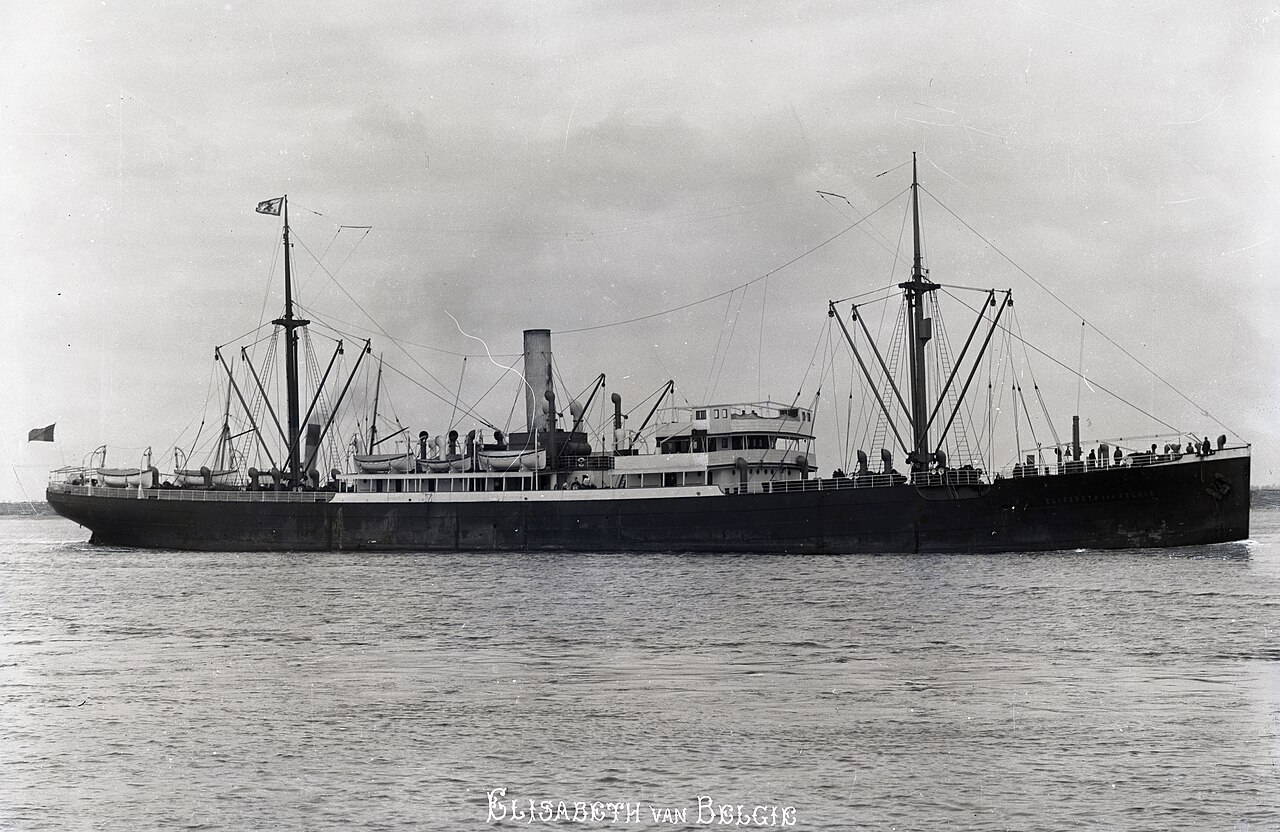
More photographs (1)
Elisabeth van Belgie. Louis Claes · Public domain · Commons
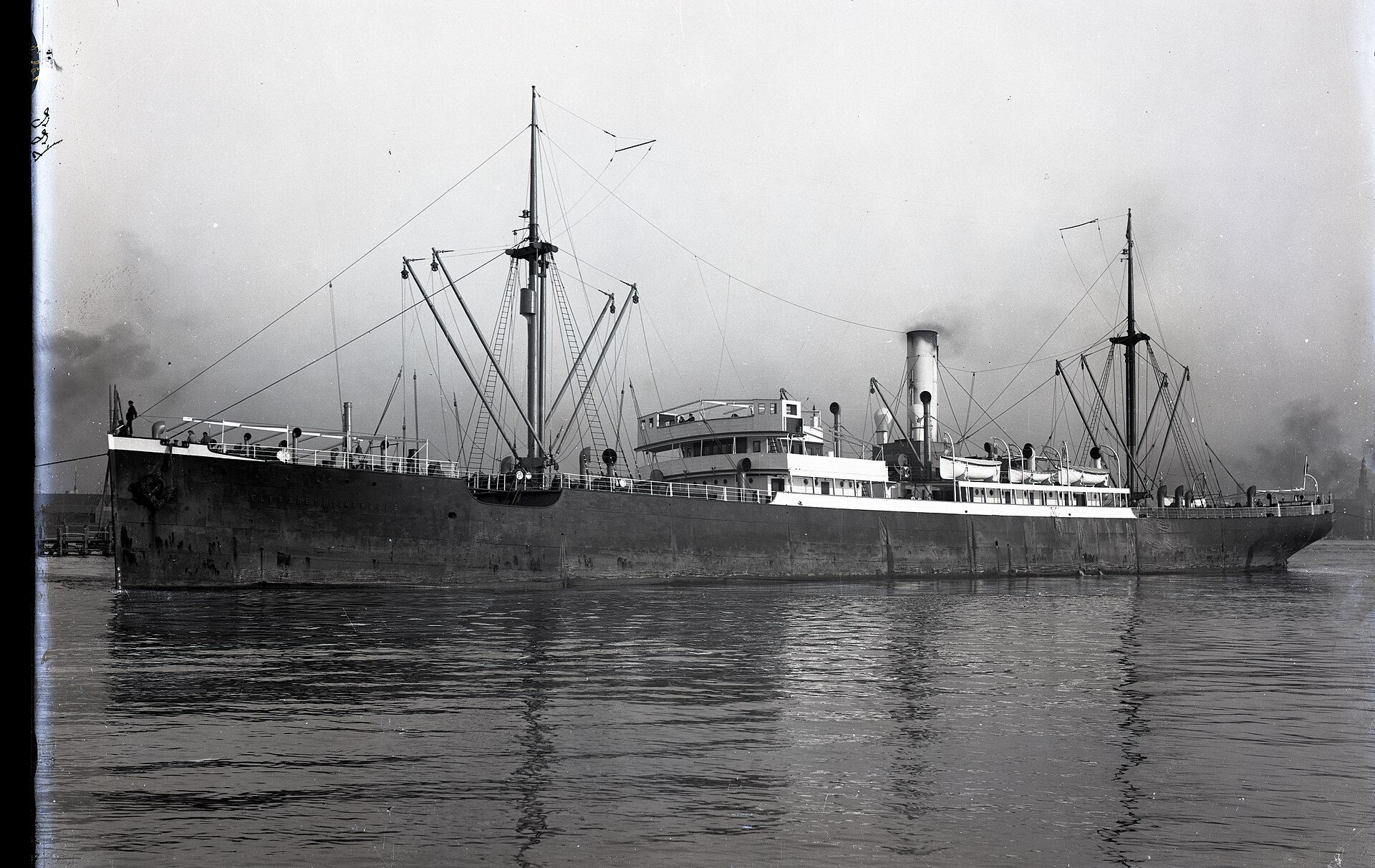
_River_Scheldt_AS.1968.001.0850.jpg)

- Type
- Steam merchant
- Tonnage
- 4,241 GRT
- Built
- 1909 – Flensburger Schiffsbau-Ges., Flensburg
- Owner
- Armement Deppe, Antwerp
- Home port
- Antwerp
- Date
- 10 September 1942
- Fate
- Sunk by U-96 (Hans-Jürgen Hellriegel)
- Attacker
- U-96 (Hans-Jürgen Hellriegel)
- Convoy
- ON-127
- Voyage
- Liverpool → Hampton Roads
- Cargo
- Ballast
- Position
- 51.5000, -28.4167 · grid AK 9929
Position of the attack. Click the map to enable zoom.
Crew list (50 names)
The voyage
- Departure
- Liverpool · 4 September 1942
- Destination
- Hampton Roads · never reached
- Sunk
- 10 September 1942
| Rank | Name | Nationality | Fate |
|---|---|---|---|
| Master (Kapitein) | Gillebert Louis | Survived | |
| 1st Officer (1ste officier) | Coucke Pierre | Survived | |
| 2nd Officer (2de officier) | Morris Robert | Survived | |
| 3rd Officer (3de officier) | Delannoy Eric | Survived | |
| 4th Officer (4de officier) | Van Heetvelde A. | Survived | |
| Radio Officer (Marconist) | Brichaux Louis | Survived | |
| Boatswain (Bootsman) | Vermeer Jan | Survived | |
| Carpenter (Timmerman) | Pano Elia | Russia | Survived |
| Able Seaman (A.B.) | Billiet Roger | Survived | |
| Able Seaman (A.B.) | Cockx Marcel | Survived | |
| Able Seaman (A.B.) | Daubanes Joseph | France | Survived |
| Able Seaman (A.B.) | De Kuyffer Jan | Survived | |
| Able Seaman (A.B.) | Deparades Ghislain | Survived | |
| Able Seaman (A.B.) | Deschacht Cyriel | Survived | |
| Able Seaman (A.B.) | Flori Marcel | France | Survived |
| Able Seaman (A.B.) | Leemand Jacob | Netherlands | Survived |
| Able Seaman (A.B.) | Roothooft Damien | Survived | |
| Chief Engineer (Chef-mecanicien) | Praast Antoine | Survived | |
| 2nd Engineer Officer (2de mecanicien) | Antonssen Frédéric | Survived | |
| 3rd Engineer Officer (3de mecanicien) | Pisa Gerhard recorded as Estonian on the s/s Bruxelles | Russia | Survived |
| 4th Engineer Officer (4de mecanicien) | Vermeer Jozef | Survived | |
| Donkeyman | Dom Jozef | Survived | |
| Donkeyman | Troch Hippolyte | Survived | |
| Donkeyman | Wathy Jean | Survived | |
| Fireman (Stoker) | Boudou Jean | Survived | |
| Fireman (Stoker) | Coldatoff Victor | Russia | Survived |
| Fireman (Stoker) | De Zitter René | Survived | |
| Fireman (Stoker) | Duzdere Ahmed | Turkey | Survived |
| Fireman (Stoker) | Marasovic Natalio | Yugoslavia | Survived |
| Fireman (Stoker) | Mintjens Jan | Survived | |
| Fireman (Stoker) | Pedorenko Effin | Russia | Survived |
| Fireman (Stoker) | Poppe Frans | Survived | |
| Fireman (Stoker) | Treve Jozef | Survived | |
| Fireman (Stoker) | Van Heurck André | Survived | |
| Fireman (Stoker) | Van Woensel Henri | Survived | |
| Fireman (Stoker) | Van Robays Michel | Survived | |
| Fireman (Stoker) | Verhuyck Jan | Survived | |
| Steward | Min Jozef | Survived | |
| Cook (Kok) | Lambrecht Antoine | Survived | |
| 2nd Cook and Baker (2de kok-bakker) | Ringelberg Pieter | Survived | |
| Assistant Steward (Assistant-steward) | Van Camp Gerard | Survived | |
| Messroom Steward (Messroom-steward) | Williams Robert | Canada | Survived |
| Cabin Boy (Cabin-boy) | †Wilson John | United Kingdom | Lost |
| Galley Boy (Koksjongen) | Davies Michel | United Kingdom | Survived |
| Gunner | Byrne Michel | United Kingdom | Survived |
| Gunner | Dangotte Jules | Survived | |
| Gunner | Fictette Camille | Survived | |
| Gunner | Nys Désiré | Survived | |
| Gunner | Saint Edward | United Kingdom | Survived |
| Gunner | Van Winckel René | Survived |
The convoy ON-127
- Route
- Outward, northbound (North Atlantic)
- Dates
- 9–14 September 1942
- Escort
- Canadian group C4: St-Croix and Ottawa with four corvettes
- Merchant ships
- 32
- Sunk
- 8 · 51,619 tons
- Damaged
- 7 · 64,915 tons
The dotted line follows the great circle the ON series ran, Liverpool to New York, with the coastal bends the fairway imposes. The red point is where the Belgian ship was hit, from the U-boat’s attack report.
About the line on this map
A convoy steered the great circle: the shortest way over the globe, not the straight line on the map. That is why the Atlantic crossing here runs so far north, and why ships on that route were hit around 55 to 58 degrees and not at 48. The bends closer to land follow the fairway – the North Channel above Ireland, round Land’s End, through the Strait of Gibraltar.
The line is the route of the series, not the track that one convoy actually steered. The Admiralty shifted convoys north or south from sailing to sailing, according to the season and where the U-boats were; ONS-154 was deliberately routed south past the Azores in December 1942. And a straggler or a dispersed ship was by definition no longer with the group. Where the red point sits far from the line, that is usually what you are looking at.
The Elisabeth van Belgie was the first ship hit. This was the only North Atlantic trade convoy of 1942 or 1943 in which every U-boat deployed against it actually fired; the Canadian destroyer Ottawa went down with it.
Convoys (25)
From the Arnold Hague Convoy Database. Convoys only, not independent voyages: a ship sailing alone does not appear. See the convoy page.
| Convoy | Departed | Route | Sunk |
|---|---|---|---|
| BHX.62 | 30 July 1940 | Bermuda – -> HX.62 | |
| HX.62 | 31 July 1940 | Halifax – Liverpool | 2 sunk |
| OB.234 | 24 October 1940 | Liverpool - Dispersed | 1 sunk |
| HX.105 | 25 January 1941 | Halifax – Liverpool | |
| WN.82 | 8 February 1941 | Clyde – Methil | |
| EC.4 | 7 April 1941 | Southend – Clyde | 1 sunk |
| OB.310 | 13 April 1941 | Liverpool - Dispersed | 2 sunk |
| BHX.131 | 4 June 1941 | Bermuda – -> HX.131 | |
| HX.131 | 6 June 1941 | Halifax – Liverpool | |
| WN.143 | 20 June 1941 | Oban – Methil | |
| FS.524 | 24 June 1941 | Methil – Southend | |
| FN.492 | 12 July 1941 | Southend – Methil | |
| EC.47 | 18 July 1941 | Southend – Clyde | |
| OS/KMS.1 | 24 July 1941 | Liverpool – Freetown | 1 sunk |
| HX.149 | 10 September 1941 | Halifax – Liverpool | |
| ON.35 | 9 November 1941 | Liverpool - Dispersed 46.09N 54.27W | 1 sunk |
| ON.37 | 15 November 1941 | Liverpool - Dispersed 59.10N 20W | |
| SC.64 | 9 January 1942 | Sydney CB – Liverpool | 1 sunk |
| ON.78 | 21 March 1942 | Liverpool – Halifax | |
| OS/KMS.25 | 12 April 1942 | Liverpool – Freetown | |
| HX.191 | 24 May 1942 | Halifax – Liverpool | |
| ON.107 | 26 June 1942 | Liverpool - Dispersed Off Halifax | |
| BX.31 | 30 July 1942 | Boston – Halifax | |
| SC.95 | 4 August 1942 | Halifax – Liverpool | 2 sunk |
| ON.127 | 4 September 1942 | Liverpool – NYC | 7 sunk |
Sources
Crew list from the printed source.